Log In
.jpg)
Free gifts available with your purchase
Note: This product is the Native version. The HD version for AAX DSP users is also available.
The 6020 Ultimate EQ is a collection of ten equalizer models using the popular module format leveraging McDSP’s decades of design experience.
All 6020 Ultimate EQ modules are designed by McDSP, drawing on inspiration from classic and modern equalizers.
Each module is easy to operate, and yet has enough sophistication for the most discerning professional.
Whatever your style, from smooth tube emulations to aggressive solid-state designs, the 6020 Ultimate EQ has a custom-made equalizer module that is just right for you.
6020 EQ Modules
E670
Fairchild made not only great compressor/limiters, they also put out a few program equalizers. The Fairchild 664, a two band EQ, served as the basis for the E670 design. Gentle low and high shelving EQ, complimented by a mid band parametric, give the E670 a smooth sound, but the three bands (each with its own gain and frequency control) provide flexibility expected in the modern studio. Suitable for subtle adjustments in any mixing situation.
Moo Q
All tube designs are known for a warm tone with tons of headroom. The Moo Q delivers these qualities and more in a three band package.
iQ
The only two-band equalizer in the 6060 collection, the iQ is surprisingly adept at fine tuning mixes in any music genre. Tracks needing some low end ‘glow’ or high end ‘sheen’ can benefit from use of the iQ module.
E300 / E301
While there may be no electro-optical attenuation in these equalizers, McDSP wanted to have equalizer modules that complimented the Opto-C/L compressor modules in the 6060 Ultimate Module Collection plug-in. The Opto-C/L modules are good general purpose compressors, with the Opto-L module operating more like a vintage limiter. In that spirit, the E300/301 modules are very utilitarian as well. The E300 and E301 three-band modules have the same frequency and gain ranges, but the E301 is a tad narrower in bandwidth, especially at higher gain settings.
British-E
McDSP’s own FilterBank plug-in, originally released in 1998, harnessed the fundamental design characteristics of the Neve line of equalizers, most notably the 1069, 1073 and 1081, with its unique Peak, Slope, and Dip controls. The British E module uses this same FilterBank technology to create an amalgamation of great Neve equalizers. The classic hpf, low shelf, parametric, high shelf combination makes the British E module useful for most mixing situations.
EZ Q
The folks at dbx did not release any parametric equalizers to match their classic compressor product line. But if they did, here at McDSP we think it would have sounded like the EZ Q. Using a high pass filter to carve out the rumble, plus capable low and high shelfs, and a fairly flexible parametric, the EZ Q gets the job done.
EQ'76
This 6060 module draws from the UREI 545 parametric equalizer. The EQ’76 has four bands of paramtric equalization with a slight Q-gain dependency. The EQ’76 design is close to that of the E300/301 modules, but using a different set of frequency ranges and a more modern gain-dependent bandwidth design.
FRG EEE
What else can compliment a compressor nicknamed ‘The Frog’ (FRG444 from the 6030 Ultimate Compressor plug-in) than an equalizer with a name like FRG EEE (pronounced ‘froggy’). Two parametrics bounded by a high and low shelf pair, the FRG EEE is a capable equalizer, not unlike what is seen in modern channel strips in analog mixing consoles.
E357
The E357 is a 3-band EQ meant to work in tandem with the D357 compressor. The slopes are steeper than most other EQ modules, and have a bit of character (like the D357). Use with caution.
Features
- Optimization for Apple Silicon and Latest Intel Processors
- Two activations per license / subscription
- High definition updated user interfaces
- New presets
- Zero Latency Algorithms
- Double Precision Processing
- Anti-Clip Output Stage Topology
- Analog Saturation Modeling
- Mono and stereo versions
- 10 EQ modules in a single interface
- Input & output control
System Requirements
Mac
- macOS 10.13 or higher (64-bit only) (macOS 12 Monterey compatible)
- McDSP plugins run natively on Intel and M1 Apple Silicon processors
- McDSP HD plugins support AAX DSP plugin format, AAX Native, AU, and VST3 plugin formats
- McDSP plugins support Mac OS 10.13.x (High Sierra), 10.14.x (Mojave), 10.15.x (Catalina), 11.x (Big Sur), 12.x (Monterey), and Windows 10
- Mac OS version 10.12.x (Sierra) may work but is not officially supported. Earlier Mac OS versions are not officially supported
Windows
- Windows 7, 8 & 10 (64-bit only)
HD v7 Software Support
- AAX DSP
- AAX Native
- Audio Units (AU)
- VST3
Compatible DAW's
- McDSP HD and Native plugins are compatible with Pro Tools, Logic Pro, Cubase, Nuendo, Ableton Live, LUNA, Reaper, Sonar, Studio One, and other DAWs that support AAX, AU, and/or VST3 plugin formats
- As of v7.0, VST is no longer supported. VST versions of v6 McDSP plugins will no longer be updated and will be uninstalled
- McDSP HD plugins also support the VENUE S6L systems. McDSP VENUE plugins are packaged in a VENUE specific installer available on the McDSP website.
Activation:
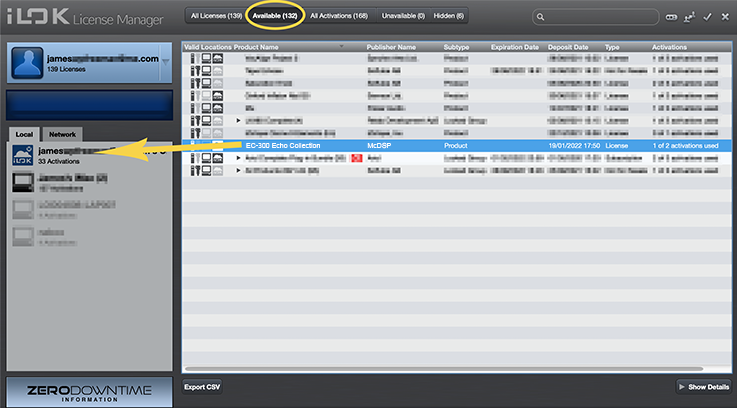
- McDSP plugins require an iLok2 or iLok3 USB Smart Key, or an iLok License Manager account and iLok Cloud for activation.
Important note: McDSP plugins require an iLok2 or iLok3 USB Smart Key, or a FREE iLok License Manager account and iLok Cloud session for authorisation. Each McDSP v7 plugin contains two activations per authorisation.
Pro Tools Expert
Pro Tools Expert offers the largest collection of free Pro Tools video tutorials in the world, videos for training, tips, tricks and reviews.
“You can hear the difference they’re making…just gives more presence in the mix.”
Three years ago this month, I reviewed the McDSP 6030 Ultimate Compressor plug-in. The 6030 consists of ten uniquely different 500 series style compressors all bundled into one plug-in. And it has since played a big role in a number of my mixes. So, needless to say, I was excited when I heard ab...
Read More